
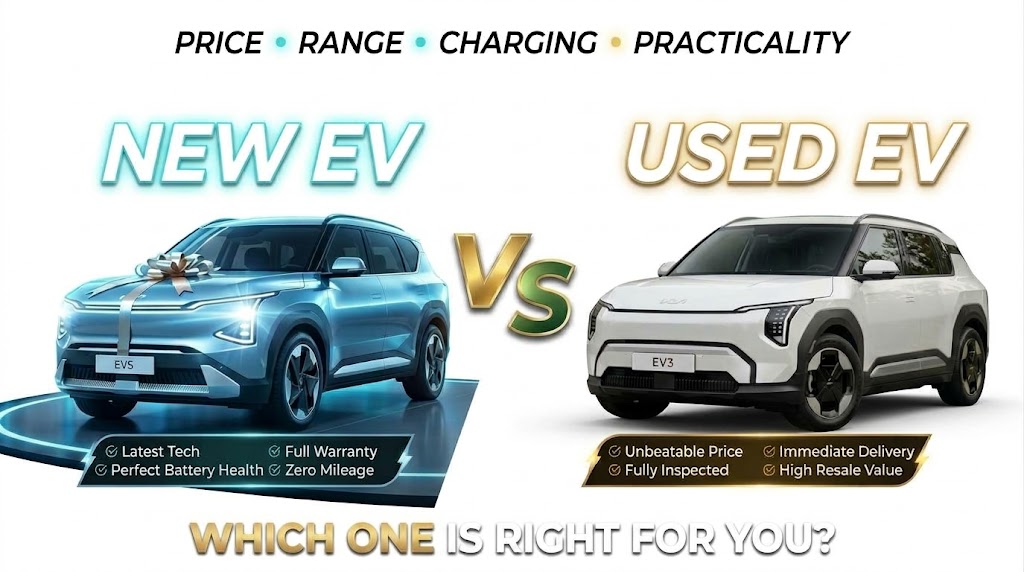
Electric cars are changing the way people travel in Nepal. With petrol and diesel expenses putting pressure on household budgets, more drivers are considering electric vehicles for daily commuting, family travel, and long-distance journeys. But as EV options expand, buyers face an important question: is it smarter to purchase a brand-new electric car or save money by choosing a second-hand EV?
The answer depends on more than the purchase price. Battery condition, remaining warranty, driving range, charging compatibility, maintenance history, depreciation, and resale value can all influence the real cost of owning an electric vehicle.
For some buyers, a used EV can provide excellent value at a significantly lower price. For others, a new electric car offers greater confidence through warranty protection, updated technology, and a fresh ownership history.
In this guide, we'll compare second-hand EV vs new EV in Nepal to help you understand the advantages, risks, and costs of both options before making your next car purchase.
Understanding Nepal's Growing Electric Vehicle Market
Electric vehicles have become an increasingly visible part of Nepal's automotive market. Models from brands such as BYD, Tata, Hyundai, MG, and other manufacturers have attracted buyers looking for alternatives to conventional petrol and diesel cars.
Several factors contribute to this interest, including fuel prices, electricity availability, lower routine maintenance requirements, and the expanding network of public charging stations.
Buyers can now explore both new and pre-owned electric cars, creating more choices across different budgets. However, the availability of used EVs also means that buyers must pay closer attention to battery condition, vehicle age, charging performance, and warranty coverage.
Government policies and customs duties also influence EV prices in Nepal. Because tax rates and incentives may change with successive budgets, buyers should check current regulations and dealership prices before deciding which vehicle offers the best value.
Second-Hand EV vs New EV in Nepal: The Quick Comparison
The biggest difference between a new and a used electric car is the balance between upfront savings and ownership confidence.
Comparison factor
New EV
Second-hand EV
Purchase price
Generally higher
Generally lower
Battery condition
New battery, subject to warranty terms
Depends on age, usage, and health
Warranty
Usually offers the original warranty
May have limited remaining coverage
Driving range
Typically closer to original specifications
Can be reduced by battery degradation
Depreciation
Initial depreciation can be substantial
Some depreciation has already occurred
Technology
Latest available features for the model
Depends on model year and trim
Maintenance
Predictable early ownership, subject to usage
May require age-related repairs
Resale prospects
Influenced by future models and market prices
Strongly influenced by battery condition
Best suited for
Buyers prioritising warranty and predictability
Buyers prioritising affordability and value
These are general comparisons rather than guarantees. Actual costs and benefits depend on the vehicle model, its age, warranty conditions, and the seller's asking price.
1. Why Buying a New EV in Nepal Can Be a Smart Decision
A new electric car is appealing to buyers who want a vehicle with no previous ownership history and the confidence of manufacturer-backed support.
Full or Remaining Manufacturer Warranty
One of the biggest advantages of purchasing a new EV is access to the manufacturer's original warranty, subject to the stated terms and conditions.
Battery and vehicle warranties can differ by brand and model. Some manufacturers offer battery coverage for several years, but buyers should confirm the precise duration, mileage limits, exclusions, and transfer conditions rather than assuming every EV has the same coverage.
For drivers planning to keep their vehicle for many years, warranty protection can provide valuable reassurance.
Newer Battery Technology and Driving Range
A new EV starts with a battery that has not experienced years of normal use and charging cycles. Its available range should generally be closer to the manufacturer's original specifications, although real-world performance still depends on temperature, road conditions, driving style, passengers, air-conditioning use, and terrain.
If you regularly travel between Kathmandu and other parts of Nepal, having a predictable range can be particularly useful when planning charging stops.
Updated Safety and Convenience Features
Newer electric cars may offer improvements in driver assistance, infotainment, charging speed, battery management, and safety equipment.
Depending on the model, these upgrades can make everyday driving more comfortable and convenient. However, a newer model is not automatically better equipped than every older vehicle, so compare the specific variants.
Easier Access to Financing and Dealer Support
New EV buyers may have access to manufacturer promotions, dealer financing arrangements, service packages, and other purchase benefits.
These offers vary over time. Compare the total financing cost, down payment, interest rate, fees, and repayment terms rather than choosing a vehicle solely because a dealer advertises a low monthly instalment.
Disadvantages of Buying a New EV
Despite its advantages, a new electric car has several drawbacks:
Higher initial investment: A new vehicle may require a larger down payment or loan.
Initial depreciation: Market prices and resale values can change after purchase.
Model availability: Some variants may have waiting periods or limited stock.
Technology changes: New models may introduce better range or features soon after you buy.
A new EV makes the most sense when your budget comfortably supports the purchase and you value warranty protection, current features, and predictable early ownership.
2. Why a Second-Hand EV May Offer Better Value
For buyers who want to enter the electric-car market without spending as much, a second-hand EV can be an attractive alternative.
Lower Purchase Price
The most obvious benefit is affordability. A pre-owned electric car may cost substantially less than its new equivalent, depending on its age, mileage, condition, variant, and current market demand.
The savings may allow you to choose a better-equipped vehicle or keep more money available for insurance, charging equipment, and other ownership expenses.
However, don't assume every used EV is automatically cheaper in the long run. A low asking price can lose its appeal if the vehicle has poor battery health or expensive repair requirements.
Reduced Exposure to Initial Depreciation
New vehicles may experience a significant reduction in resale value during their early ownership years. Buying a used EV means the first owner has already absorbed some of that depreciation.
This can be beneficial if you plan to own the vehicle for several years and purchase it at a fair market price.
Nevertheless, EV resale values can change quickly as newer models, battery technologies, and pricing strategies enter the market. A used vehicle's future resale value is never guaranteed.
More Features Within Your Budget
A buyer with a fixed budget may find that a pre-owned higher-specification EV offers more comfort or convenience than a new entry-level model at a similar price.
For example, you might compare a used SUV-style electric car with a new compact EV. Consider not just the purchase price but also battery health, available range, safety features, charging performance, and expected maintenance.
A Practical Option for Daily Commuting
If your driving mainly involves short trips around Kathmandu Valley, a carefully inspected used EV may provide all the range you need.
For many city drivers, a vehicle that comfortably covers daily travel and can be charged overnight may be more economical than paying extra for a new model with a longer range they rarely use.
Risks of Buying a Second-Hand EV
Used electric cars also come with risks that should not be ignored:
Reduced battery capacity and driving range
Expired or non-transferable warranty coverage
Incomplete service and repair records
Previous accidents, water damage, or poorly repaired bodywork
Charging faults or problems with electronic components
Limited availability of replacement parts for some models
Uncertainty about future resale value
The solution is not to avoid used EVs altogether. Instead, evaluate the vehicle carefully and make sure the price reflects its actual condition.
3. Battery Health: The Most Important Factor When Buying a Used EV
When comparing a second-hand EV with a new electric car, battery condition deserves special attention.
An EV's high-voltage battery gradually loses capacity through normal ageing and use. This process is commonly called battery degradation. As capacity declines, the vehicle may travel fewer kilometres between charges.
Two electric cars of the same model and year can have different battery conditions because of their charging habits, driving patterns, climate exposure, and maintenance history.
What Is Battery State of Health (SOH)?
State of Health, or SOH, is a measure used to describe a battery's condition relative to its original or reference capacity.
For example, a battery reported at 90% SOH may have approximately 90% of its reference capacity remaining. However, the precise interpretation depends on the diagnostic method and the vehicle manufacturer's system.
Do not rely on a seller's verbal claim or dashboard range estimate alone. Ask for a battery diagnostic report from an authorised service centre or a qualified EV technician.
There is no single SOH percentage that makes every used EV a good purchase. The acceptable condition depends on the model, vehicle price, remaining warranty, expected driving needs, and repair risks.
How to Evaluate Battery Condition
Before buying a used electric car, consider these checks:
Request a battery diagnostic report. Ask a qualified technician to assess battery health, recorded faults, and any available cell-level information.
Compare expected and actual range. A road test can help you understand real-world efficiency, but a short drive alone cannot accurately establish total battery capacity.
Inspect charging performance. Confirm that the car charges correctly and that its charging connections and equipment work as expected.
Review the service history. Look for documented battery repairs, software updates, warning messages, and other significant work.
Verify the warranty. Confirm directly with the manufacturer or authorised dealer whether the battery warranty remains active and whether it transfers to a new owner.
A professional inspection is one of the most useful investments you can make before purchasing a used EV.
4. How Much Does EV Battery Replacement Cost in Nepal?
Battery replacement can be one of the most expensive repairs associated with an electric vehicle. The actual cost varies significantly depending on the brand, model, battery capacity, availability of parts, labour, and whether repair or replacement is possible.
A replacement battery may represent a substantial share of a used EV's market value, making it important to understand the risk before purchasing an older vehicle.
Before committing to a used EV, ask an authorised service provider about:
Battery warranty coverage and exclusions
Estimated replacement cost, if available
Availability of battery modules or complete packs
Local repair and service support
Whether the vehicle has recorded battery faults
Do not assume that an expensive battery replacement will definitely be necessary just because a car is several years old. Equally, do not assume the battery will remain trouble-free throughout your ownership.
The objective is to understand the vehicle's current condition and make an informed decision based on evidence.
5. Total Ownership Cost: New EV vs Second-Hand EV
The purchase price is only one part of the cost of owning an electric car. To compare two vehicles fairly, estimate the expenses you expect to face over the period you plan to keep them.
Cost factor
New EV
Second-hand EV
Initial payment
Usually higher
Usually lower
Financing
Depends on loan terms
Depends on loan terms and eligibility
Routine servicing
Generally limited compared with petrol cars
May be higher if age-related work is needed
Battery-related risk
Covered only to the extent of warranty terms
Depends on condition and remaining coverage
Insurance
Depends on vehicle value and coverage
Depends on vehicle value and coverage
Depreciation
Depends on future prices and demand
Depends on purchase price, age, and battery health
Repairs
Often more predictable early on
Potentially less predictable
Resale value
Depends on future market conditions
Particularly sensitive to battery condition
Routine Maintenance Costs
Electric cars generally have fewer routine powertrain maintenance requirements than conventional petrol or diesel vehicles. They do not require engine oil changes, and they have no conventional exhaust system or engine timing belt.
However, EVs still need tyre checks, brake inspections, suspension maintenance, cabin-filter replacement, coolant servicing where applicable, and other model-specific maintenance.
A used EV may need additional attention because of age, previous driving conditions, or neglected servicing.
Charging Costs
Charging expenses depend on electricity tariffs, charging efficiency, and how much of your charging takes place at home versus public stations.
If home charging is available, an EV can be particularly convenient for regular city use. Public charging may cost more depending on the provider and charging method.
When comparing a new and used EV, estimate the energy cost for your typical monthly distance rather than relying solely on the advertised range.
Depreciation and Resale
A new EV may experience more depreciation during the first years of ownership. A used EV can offer better value if bought at an appropriate price, but it may also lose value more quickly if its battery condition deteriorates or newer models become significantly more attractive.
Compare the total expected cost of ownership rather than assuming the lowest purchase price will produce the greatest savings.
6. Charging Infrastructure and Daily Driving in Nepal
Charging access should be part of your buying decision, especially if you regularly travel outside major cities.
Charging in Kathmandu Valley
For drivers who have a suitable parking space and access to home charging, daily EV ownership can be relatively convenient. You can charge when the vehicle is parked and begin most days with sufficient energy for your planned journeys.
If you live in an apartment or rent your parking space, confirm that charging installation is permitted and technically practical before purchasing an EV.
Long-Distance Travel
Trips between Kathmandu, Pokhara, Chitwan, and other destinations require more planning than a typical city commute.
Consider the vehicle's realistic highway range, elevation changes, passenger and luggage load, charging compatibility, and availability of functioning charging stations along your route.
A newer EV may provide a longer range than an older used model, but the comparison should be based on the specific vehicles rather than age alone.
Check Charging Compatibility
Before purchasing a used EV, verify its AC and DC charging capabilities, connector types, charging limits, and compatibility with the charging networks you expect to use.
Do not assume every electric vehicle supports every public fast charger.
7. Government Taxes and EV Prices in Nepal
Government tax policies can influence the price difference between new and used electric cars. Customs duties, excise duties where applicable, and other taxes or charges may vary with the government's current fiscal policies.
These changes can affect showroom prices and the resale market for pre-owned EVs.
Before buying, compare current dealer quotations with the asking prices of similar used vehicles. Check whether a new vehicle includes any manufacturer promotions, service packages, or financing offers that narrow the price gap.
For current customs information, consult Nepal's Department of Customs and confirm the applicable details with the dealer or relevant authority.
A used EV is not automatically the better financial choice just because its advertised price is lower. What matters is the final price relative to its condition, equipment, warranty, and expected running costs.
8. Which Is Better for Different Types of Buyers?
The right option depends on your circumstances and how you intend to use the vehicle.
Choose a New EV If:
You have the budget for a new vehicle without stretching your finances.
You want manufacturer-backed warranty protection from the beginning.
You prefer the latest available technology and safety features.
You plan to keep the car for a long time.
You want a vehicle with no previous ownership or repair history.
Choose a Second-Hand EV If:
You want to reduce the initial purchase cost.
Your daily travel requirements are relatively predictable.
You can arrange a professional battery and vehicle inspection.
The vehicle has a transparent service and ownership history.
Its price reflects the battery condition and remaining warranty.
You have researched local servicing and charging support.
What If You're a First-Time EV Buyer?
If you're new to electric cars, start by calculating your typical daily distance and identifying where you can charge.
A used EV may be a sensible choice if it meets your needs and passes a professional inspection. However, if you have limited tolerance for unexpected repairs or cannot verify the battery condition, buying a new EV with suitable warranty coverage may offer greater peace of mind.
Neither option is universally better. The best choice is the vehicle that matches your budget and driving requirements without exposing you to unnecessary financial risk.
9. How to Find the Right Electric Car on Wheelmandu
Comparing several vehicles is often more useful than deciding immediately between new and used.
On Wheelmandu, you can explore available vehicle listings and compare options according to your budget, preferred model, and requirements.
Before contacting a seller, prepare a shortlist and compare the following details:
Asking price and model year
Battery capacity and available battery-health information
Advertised range and realistic driving needs
Remaining manufacturer warranty
Service and repair records
Accident history and overall vehicle condition
Charging compatibility
Registration documents and ownership status
If two EVs have similar prices, prioritise the one with clearer service records, a verified battery condition, and better support for your driving needs.
Always verify the vehicle information directly with the seller and arrange an independent inspection before making payment.
Conclusion: Should You Buy a Second-Hand EV or a New EV in Nepal?
The choice between a second-hand EV and a new EV comes down to affordability, battery condition, warranty protection, and your long-term driving plans.
A new electric car offers the benefit of a new battery, access to the applicable original warranty, and newer features. It can be a strong choice for buyers who value predictability and are comfortable with the higher upfront cost.
A second-hand EV can deliver excellent value when the price is fair, the battery is in good condition, the paperwork is complete, and the vehicle's history is transparent. It can be especially appealing to drivers who mainly commute around the city and want to spend less initially.
Before making a decision, compare the purchase price, expected running costs, battery health, charging access, and likely resale value.
Ready to find your next electric car? Explore vehicle listings on Wheelmandu, compare new and second-hand options, and choose an EV that fits your budget and lifestyle.
Frequently Asked Questions (FAQs)
1. Is it worth buying a second-hand EV in Nepal?
Yes, a used EV can be worthwhile if it has a healthy battery, a reasonable asking price, complete documentation, and a reliable service history. A professional battery inspection is strongly recommended before purchasing.
2. How long does an electric car battery last?
Many modern EV batteries are designed to last for many years, and some remain in service for a decade or longer. Actual lifespan depends on battery chemistry, usage, charging habits, climate, and maintenance. Warranty periods vary by manufacturer and model.
3. What should I check before buying a used EV?
Check the battery diagnostic report, real-world driving range, charging performance, service history, accident records, remaining warranty, and ownership documents. Have the car inspected by a qualified EV technician.
4. Is maintaining an EV cheaper than maintaining a petrol car in Nepal?
Routine maintenance is often less expensive because electric cars have fewer conventional powertrain components. However, tyres, suspension, brakes, cooling systems, electronics, and battery-related repairs can still involve significant costs.
5. Is a new EV better for first-time buyers?
A new EV may suit first-time buyers who want warranty protection, newer features, and predictable early ownership. A professionally inspected used EV may be more affordable and equally practical for some driving needs.
6. Does a used EV have a valid battery warranty?
It depends on the manufacturer, model, vehicle age, mileage, and warranty terms. Verify the remaining coverage directly with the authorised dealer or manufacturer before purchasing.
7. Can a second-hand EV handle long-distance travel in Nepal?
Yes, provided the vehicle has sufficient real-world range and compatible charging options along the route. Plan charging stops carefully and account for road gradients, weather, passengers, and luggage.
8. Which is more economical: a new EV or a used EV?
A used EV generally costs less upfront, while a new EV may offer stronger warranty protection and lower early repair uncertainty. The more economical choice depends on the purchase price, battery condition, financing, depreciation, and how long you intend to own the vehicle