Buying a second-hand car in Nepal can be an exciting experience, especially when you finally find a vehicle that fits your budget, lifestyle, and expectations. However, before negotiating the final price or handing over your money, there is one important step you should never overlook: checking the paperwork.
A car may look perfect on the outside, but incomplete documents, unpaid road taxes, unresolved bank loans, or ownership discrepancies can turn a seemingly good deal into a costly problem. Even if the seller appears trustworthy, verifying the vehicle's legal status is essential.
Whether you're purchasing your first car in Kathmandu or upgrading to a different model, understanding the documents required to buy a second-hand car in Nepal will help you complete the transaction more confidently and avoid unnecessary complications.
This guide covers the documents buyers should prepare, the paperwork sellers must provide, and the essential steps involved in transferring vehicle ownership.
1. Essential Documents Required to Buy a Used Car in Nepal
Before finalizing a purchase, make sure both parties have the necessary documents ready. Requirements can vary depending on the vehicle, its financing status, and the relevant Transport Management Office.
The main documents to check include:
- Buyer's citizenship certificate or other accepted identification
- Recent passportsize photographs, if required
- Original vehicle Bluebook
- Vehicle tax payment receipts or tax clearance records
- Valid vehicle insurance documents
- Signed vehicle sale agreement, commonly known as Bikri Patra
- Bank loan clearance certificate or No Objection Certificate (NOC), if applicable
- Official ownershiptransfer application
- Witness identification documents, if required by the office
- Company registration and authorization documents for business purchases
Having these documents prepared in advance can make the ownership-transfer process more straightforward.
2. Documents Buyers Should Prepare Before Purchasing
Buyers are responsible for providing identification and completing the necessary ownership-transfer formalities. Preparing your paperwork before meeting the seller can save time and reduce delays.
Citizenship Certificate or Valid Identification
For Nepali citizens, a citizenship certificate is commonly used to verify identity during vehicle ownership transfer. Carry the original document and photocopies as requested by the relevant office.
Foreign nationals and Non-Resident Nepalis may need additional identification or supporting documents, depending on their legal status and the applicable registration requirements. Confirm the exact requirements with the concerned Transport Management Office before proceeding.
Passport-Size Photographs
Some offices request recent passport-size photographs for transfer applications and related records. Carrying a few extra photographs is a simple way to avoid an unnecessary return trip.
Company Documents for Business Purchases
If the vehicle will be registered in a company or organization's name, additional documents may be necessary. These can include the company's registration certificate, PAN or VAT registration details, and authorization from the appropriate company representative.
Individual buyers generally do not need company-related paperwork.
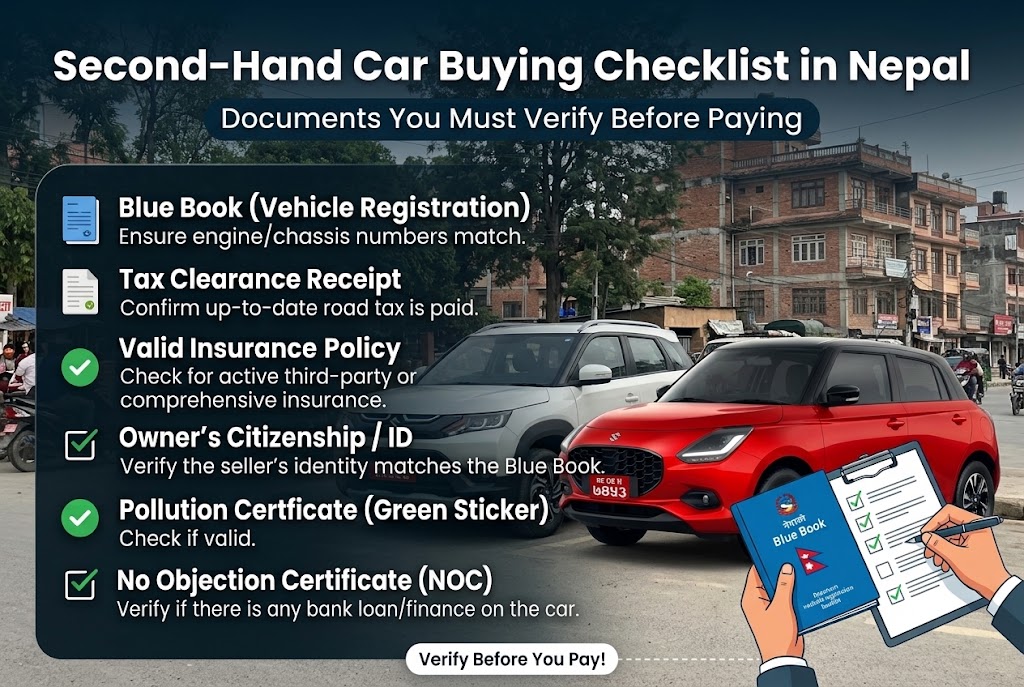
3. The Original Bluebook: The Most Important Document to Check
The vehicle's Bluebook, or registration certificate, is one of the most important documents in a used-car transaction in Nepal.
It contains essential information such as the registered owner's details, registration number, engine number, chassis number, and other vehicle particulars.
Before agreeing to buy the car, compare the details in the Bluebook with the actual vehicle. Pay particular attention to the engine and chassis numbers, as discrepancies may create serious problems during verification or ownership transfer.
Never rely solely on a photograph or photocopy of the Bluebook. Ask to inspect the original document and verify that the person selling the vehicle is legally authorized to transfer ownership.
If the Bluebook is held by a bank or financial institution, investigate the reason before making any payment.
4. Check Road Tax and Outstanding Dues
Unpaid vehicle tax can delay the transfer process and create additional expenses for the buyer.
Ask the seller to provide available tax payment receipts and confirm the vehicle's tax status with the relevant Transport Management Office. You should also clarify whether any outstanding fines, penalties, or other dues need to be settled before the transfer.
Before finalizing the price, agree in writing on who will pay any remaining tax or outstanding charges.
This simple precaution helps prevent disagreements after the transaction has been completed.
5. Is a Bank Loan Clearance Certificate Necessary?
Not every used car comes with a financing history, but buyers should always ask whether the vehicle was purchased through a bank loan or other financing arrangement.
When a vehicle is under an active financing restriction or hypothecation, the lender may retain control over the registration documents or require its approval before ownership can be transferred.
In such cases, the seller may need to provide a loan settlement confirmation, clearance letter, or No Objection Certificate (NOC), depending on the lender's requirements and the vehicle's registration status.
If the loan has not been cleared, do not assume that paying the seller the full purchase price will automatically resolve the issue.
A safer approach is to confirm the outstanding balance directly with the lender and arrange any agreed settlement through a documented process. Complete the ownership transfer only after the necessary clearance has been obtained.
6. Prepare a Written Sale Agreement (Bikri Patra)
A verbal agreement is not enough protection when a substantial amount of money is involved.
A written sale agreement, commonly called a Bikri Patra, records the essential details of the transaction. It should clearly identify the buyer and seller, describe the vehicle, state the agreed purchase price, and specify the sale date and relevant conditions.
The agreement should also clarify how outstanding taxes, loan settlements, and other liabilities will be handled.
Both parties should retain a signed copy. Notarization or additional authentication may be advisable depending on the circumstances and the applicable requirements.
A properly documented agreement can help resolve disputes about payment, vehicle condition, or the terms of the sale. However, the sale agreement alone does not replace the official ownership-transfer process.
7. Don't Forget Vehicle Insurance
Insurance is another important part of buying a used car in Nepal.
Ask the seller to show the existing insurance policy and verify its validity, coverage, and expiry date. Motor vehicle insurance requirements depend on the applicable law and vehicle category, so confirm that the necessary cover is in place.
Do not assume that an existing policy automatically provides the same protection after the vehicle changes ownership. Contact the insurer to understand the required transfer, endorsement, or new-policy procedure.
Before driving the vehicle, ensure that the necessary insurance arrangements are valid and properly documented.
8. Do You Need an Emission or Fitness Certificate?
Additional technical documents may be required depending on the vehicle's age, category, registration status, and intended use.
Commercial vehicles and certain older vehicles may be subject to fitness inspections, emission testing, or other compliance requirements. These rules should not be assumed to apply identically to every private passenger car.
Ask the relevant Transport Management Office whether the specific vehicle requires any additional certificates before the transfer can be approved.
This is particularly important if you're buying an older vehicle or a car previously used for commercial purposes.
9. How Does the Ownership Transfer Process Work?
After checking the paperwork and agreeing on the purchase terms, the next step is to complete the official ownership transfer through the relevant Transport Management Office.
The process generally involves the following steps:
Step 1: Verify the documents. Check the original Bluebook, identity documents, tax status, insurance, and any applicable loan-clearance paperwork.
Step 2: Complete the required application. Buyer and seller must provide the information and signatures required by the relevant office. Confirm the correct form and supporting documents before submission.
Step 3: Attend verification when required. The office may require the parties to appear in person and may request witness details, biometric verification, or additional checks.
Step 4: Pay applicable fees and clear outstanding dues. Confirm the current transfer charges and settle any required payments.
Step 5: Obtain confirmation of the ownership transfer. Follow up until the official registration record reflects the new owner. Keep copies of the agreement, payment records, and transfer documents.
The exact procedure may vary by office and vehicle circumstances, so confirm the current process before visiting.
10. How Soon Should You Transfer Ownership?
Do not leave the ownership-transfer process until weeks or months after purchasing the vehicle.
The applicable rules may impose a deadline for submitting transfer documents, and delays can lead to penalties or disputes over responsibility for the vehicle.
The 15-day period is commonly cited in discussions of vehicle transfers in Nepal, but buyers should verify the current statutory deadline and how it applies to their transaction with the relevant Transport Management Office.
The safest approach is to begin the transfer process immediately after finalizing the sale rather than relying on an informal promise from the seller.
Until the official records are updated, the previous owner may continue to appear as the registered owner, creating potential complications involving fines, notices, or other liabilities.
11. Common Documentation Mistakes Used-Car Buyers Should Avoid
Even buyers who carefully inspect a car's condition can overlook important paperwork. Watch out for these common mistakes:
Buying without checking the original Bluebook: Always verify the vehicle's registered ownership and identification numbers.
Ignoring unpaid taxes or fines: Confirm the outstanding balance before agreeing on the final price.
Overlooking an existing bank loan: Obtain the necessary lender clearance before proceeding with a restricted vehicle.
Accepting incomplete sale documents: Record the transaction terms clearly and keep signed copies.
Assuming insurance transfers automatically: Verify the policy's status and the insurer's requirements.
Paying the full amount before checking transfer eligibility: Confirm that the vehicle can legally be transferred before making an irreversible payment.
Delaying the official transfer: Start the process promptly and retain evidence of every important step.
A few minutes of verification can prevent weeks of paperwork problems and potentially significant financial losses.
12. Final Checklist Before You Pay for a Second-Hand Car
Use this checklist when inspecting a car or meeting a seller.
- [ ] Inspect the original Bluebook.
- [ ] Match the engine and chassis numbers with the vehicle.
- [ ] Confirm the seller's identity and authority to sell.
- [ ] Verify the vehicle's tax status and outstanding dues.
- [ ] Check the insurance policy and required coverage.
- [ ] Confirm whether a bank loan or financing restriction exists.
- [ ] Obtain the necessary loan clearance, if applicable.
- [ ] Prepare a written sale agreement.
- [ ] Confirm the transfer requirements and applicable fees.
- [ ] Agree on payment terms and retain proof of payment.
- [ ] Complete the official ownership transfer promptly.
Do not make the final payment simply because the vehicle looks good or the seller is offering an attractive price. First, make sure the documentation supports a legal and straightforward transfer.
Conclusion: Verify the Paperwork Before Buying Your Next Car
Buying a second-hand car in Nepal requires more than comparing prices, checking mileage, and inspecting the engine. Legal ownership, tax clearance, financing status, insurance, and transfer documents are equally important.
The original Bluebook should be your starting point, followed by checks on the seller's identity, outstanding dues, loan restrictions, and the documents required by the relevant Transport Management Office.
A well-maintained car with complete documentation is generally a safer purchase than an apparently cheaper vehicle with unresolved paperwork.
If you're planning to buy or sell a used car, take the time to verify the details before making a financial commitment. Doing so can help you avoid unexpected expenses and enjoy greater confidence in your purchase.
Ready to find your next vehicle? Explore available listings on Wheelmandu and compare second-hand cars in Nepal while keeping ownership verification and documentation at the top of your checklist.
Frequently Asked Questions (FAQs)
1. What documents are required to buy a second-hand car in Nepal?
Commonly required documents include the buyer's identification, the original Bluebook, tax-clearance records, insurance documents, a signed sale agreement, and the official ownership-transfer application. Additional documents may be necessary depending on the vehicle and the parties involved.
2. Can I purchase a used car without the seller being physically present?
A representative may be able to act on the seller's behalf when the required legal authorization is accepted by the relevant office. Confirm the acceptable form of authorization and supporting documents before proceeding.
3. Can I buy a second-hand car if the bank loan has not been fully repaid?
A vehicle subject to an active financing restriction generally cannot be transferred until the lender's requirements have been satisfied. Confirm the outstanding loan balance and obtain the necessary clearance before completing the purchase.
4. Is a Bikri Patra mandatory when buying a used car?
A written sale agreement is an important record of the transaction. The exact documentation and authentication requirements should be confirmed with the relevant Transport Management Office. A sale agreement does not replace official ownership transfer.
5. Do I need to pay the previous owner's outstanding road tax?
Outstanding tax and other dues must be addressed according to the applicable requirements before the transfer can be completed. Buyer and seller should agree in writing on who will settle any outstanding amount.
6. How long does a vehicle ownership transfer take in Nepal?
The processing time depends on the relevant office, document completeness, outstanding dues, and any additional verification required. Prepare the paperwork in advance and confirm the current procedure with the office handling the transfer.
7. Can I drive the car immediately after paying the seller?
Payment alone does not establish that all legal requirements have been completed. Before driving, confirm that the vehicle's registration, insurance, and other applicable requirements are satisfied, and arrange the ownership transfer without delay.
8. What should I do if the seller has lost the original Bluebook?
Do not proceed as though a photocopy is sufficient. Ask the seller to resolve the missing-document issue through the appropriate registration authority and verify the vehicle's legal status before making payment.